Masonic Pyramid Symbol Grid
The Lost SymbolThe Masonic Pyramid Symbol Grid is the pyramid’s encoded message and the key to its successive revelations: first a decipherable cipher, then a sixty-four-symbol pattern reordered through a magic square, and finally an image whose apparent staircase can be read either as a physical route or as a symbol. Its meaning is not delivered all at once. The grid changes as its readers bring different methods and assumptions to it, making the difference between finding a pattern and understanding it central to the search for the Lost Word.
Inscription and First Decoding
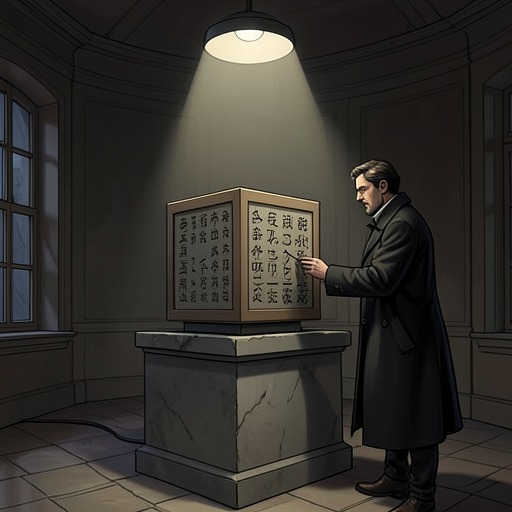
The grid is inscribed on the Masonic Pyramid, an object Robert Langdon initially regards as bearing a code simple enough for almost anyone to decipher. Warren Bellamy presents the golden capstone as the key, or legend, to reading the pyramid: in his account, the pyramid is a map, and the capstone tells its reader how to interpret it. Langdon is skeptical that the inscription could lead to a hidden treasure, but agrees to examine it.
He approaches the first code as a Masonic substitution cipher. Its key consists of four grids—two plain and two dotted—with the alphabet placed in order inside distinct shapes. Each enclosing shape stands for the letter inside it. Matching the pyramid’s symbols to those shapes turns them into letters; Langdon begins with a chalice-like mark that yields S, followed by shapes yielding O and E, and continues through the inscription. The important result in this passage is the method: the marks are not read as an unfamiliar alphabet but translated through a known cipher. The decoded material supplies a further clue rather than ending the investigation.
A separate set of seven small marks on Peter Solomon’s palm complicates the investigation and helps connect the pyramid’s clues to a location. At first, Langdon and Inoue Sato consider whether the characters combine Roman and Arabic numerals, or perhaps runes. Langdon recognizes the danger of assigning different marks to different symbolic systems. To test a consistent reading, he turns the wooden base holding Peter’s hand upside down. From that orientation, the marks become a valid Roman numeral, XIII, followed by SBB in Roman letters. The reversal makes the same physical marks legible in a single system and supplies the designation SBB XIII. The palm marks are not the pyramid grid itself, but their solution develops the novel’s recurring principle that orientation can alter what a sign says.
The Magic-Square Method
The pyramid’s later message uses a more elaborate operation. Langdon and Katherine Solomon connect the grid’s layout to the four-by-four magic square in Albrecht Dürer’s engraving Melencolia I. Katherine verifies that the rows and columns add to thirty-four; Langdon also explains that Dürer arranged the numbers so that the diagonals, four quadrants, central four squares, and corner four squares share that total. The paired numbers 15 and 14 in the bottom row indicate the year of the engraving, 1514. For Langdon, this numerical pattern is not merely a mathematical curiosity: it links the pyramid’s four-by-four letter arrangement to the history of magic squares and to the transmission of the Ancient Mysteries.
The final code expands this principle to an eight-by-eight grid. Mal’akh learns that Langdon has identified the clue as an order-eight magic square, and that Benjamin Franklin created a famous example using the numbers one through sixty-four. In Franklin’s arrangement, rows, columns, and diagonals share a constant, while the distinctive bent-diagonal sums are also part of the square’s reputation. Mal’akh applies its number sequence to reorganize the pyramid’s sixty-four symbols. The new order makes them cohere into meaningful groups and causes an image of a staircase beneath a pyramid to emerge from what had looked like chaos.
A Staircase Read Literally and Symbolically
The newly ordered image has an immediate but misleading force for Mal’akh. He takes the staircase as evidence that a real staircase lies beneath the House of the Temple and presses Peter to disclose its entrance, threatening Katherine in order to compel him. Peter recognizes the image but understands the staircase differently. In Masonic symbolism, the Winding Staircase represents an intellectual ascent toward divine truth, with its steps associated with the mind’s virtues; it is not necessarily a concealed architectural passage. Peter therefore tells Mal’akh that a secret staircase exists, but this is a lie intended to buy time and protect his sister.
The image also carries bodily meaning in Peter’s account of Masonic symbolism. He relates the staircase to the spine, through which energy is imagined to ascend and descend between the physical body and the mind. The thirty-three vertebrae echo the thirty-three degrees of Masonry, while the sacrum’s name connects the body to the sacred. This interpretation places the staircase within a larger symbolic structure in which the body itself is a temple and the mind sits, figuratively, as its capstone. Mal’akh’s belief that the image points to a literal route thus differs sharply from Peter’s understanding of it as an allegory of human development.
The Grid as Pictogram and Map
After the ordeal at the House of the Temple, Peter shows Langdon the completed pyramid and the reorganized array. Langdon first reads it as an allegorical pictogram: Heredom at the top signifies a holy house or heaven; the downward arrow marks the realm below; and the pyramid rises from earth toward heaven. At its base he sees twelve astrological signs, while the pyramid gathers philosophies and religions into a movement toward a unified human philosophy. The circumpunct above the capstone represents a universal symbol of God. This reading interprets the grid as an image of spiritual and intellectual convergence, not as a set of literal directions.
Peter then asks Langdon to change his perspective. He invokes the Masonic convention of placing a cornerstone in a building’s northeast corner to receive the first rays of morning light, directing Langdon to begin reading the grid at its northeast corner. There, the downward-pointing arrow can be understood not as beneath the word Heredom but as south on a map. Heredom, in this reading, names a geographic location rather than heaven. Peter further confines the search to Washington, D.C., and points to the seven symbols in the third row as the inscription described in the legend: a message on a large stone marking the opening. Langdon has encountered those symbols without recognizing their function. The grid’s final shift is therefore from cosmological picture to map, with the image’s symbolic and geographic readings held in tension.
The grid’s significance rests on these successive acts of reading. Its first cipher teaches Langdon to match shapes with letters; its later arrangement makes a staircase visible; and its completed image supports both a symbolic account of human ascent and Peter’s geographic interpretation. Mal’akh treats the staircase as a promise of physical access to hidden power, while Peter uses his knowledge of Masonic allegory to recognize the trap in that literal reading. The grid does not simply conceal an answer in its symbols: it tests whether its interpreter can distinguish a sign’s appearance from the meaning supplied by context.